Monday, 23 January 2012

Ghost Town: SFU's Absent Arts Community


I’m not the first to observe the state of SFU’s arts community — or put more broadly, culture community. There is a unique aspect to SFU: our main campus resides on a mountain. Sure, the view may be nice and the air may be fresh, but what does this cloudy isolation do for our sense of community? I ventured to several SFU campuses to get a feel for our arts community and how it functions within our body politic.

SFU Woodward’s was an obvious first choice, being the home for contemporary arts. I wandered in on a Tuesday afternoon, feeling varying degrees of intimidation as I went into the Audain Gallery to see the current exhibit, Mapping the Everyday: Neighborhood Claims for the Future. I found myself alone in the white room, black script covering the walls. Artifacts of various art forms made islands in the center of the room: old computer monitors, dried rainbow paintbrushes, rolls of canvas, and old VHS tapes were stacked haphazardly on several desks and bookshelves. I found the evidence of art, of things being created in and around SFU, but I couldn’t find a single soul to tell me about it. It was beautiful, but barren. An arts community does not exist solely in a gallery of course, but while there was art, there seemed to be no community.

Instead of making assumptions based on my outsider’s viewpoint, I decided to talk to a student who might have a bit more insight. Jessica Han recently graduated from SFU with a major in film and a minor in theatre production. She explains that the film program operates on a cohort system, meaning you go through four years with relatively the same people. Theatre is more mixed, but Han explains that what makes the community within the programs is the very nature of the program itself. “You have performance and production students working together on a school production. Theatre is a collaborative process in itself. When you’re collaborating, you develop relationships, and relationships make for a community. We go to each other’s project presentations to show our support,” she said.

This may be the case for the contemporary arts departments at SFU Woodward’s, but does this exist at the other campuses? “The community is fairly exclusive, especially now that we’ve moved downtown to SFU Woodward’s. But when we were on the Burnaby campus, other students didn’t even know [the FPA department] existed!” Han said.

The main vessel of the Burnaby campus, the AQ, holds the SFU Gallery, a tiny space nestled among science lecture halls.  The current exhibit by Lawrence Weiner, A Selection from the Vancouver Art Gallery Archive of Lawrence Weiner Posters, highlights the relationship between art and words.
Bill Jeffries is the art director of the gallery and has been working with SFU for several years. “Things didn’t used to be this way,” Jeffries said as he recalled SFU in the ‘80s when staff and students alike would go to the theatre, then spend hours in the campus pub. Now that the arts departments have been moved to the Woodward’s campus, there seems to be a lack of cultural capital up on Burnaby Mountain. He makes the valid point that the notion of community is flexible, and yet there doesn’t seem to be much happening ‘culturally’ at SFU.

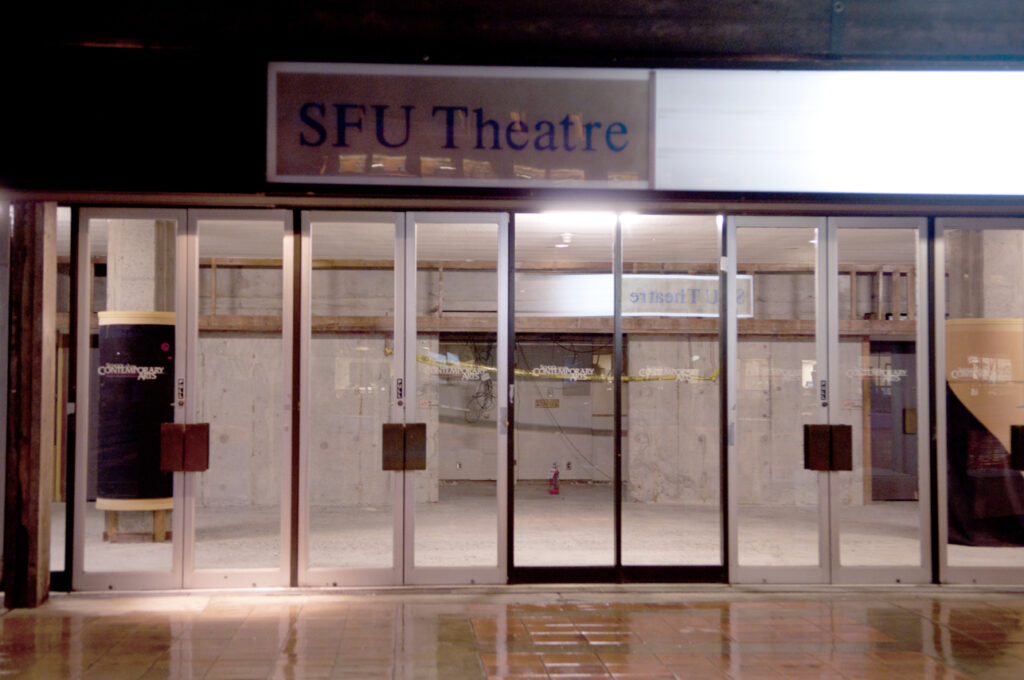
“There’s no easy way to reach the students,” he said, concerning the amount of information provided for events like gallery openings and theatre performances. In the same vein, he also noted that the old theatre in the convocation mall is being turned into a lecture hall.

Andrew Zuliani, an English major at SFU, puts the state of the arts community more bluntly. “There isn’t one,” he said. “SFU is mainly a commuter school. There is constant relocation. By the time something gets started up and you get settled down, you graduate.”

Zuliani finds one of the biggest issues to be the lack of information provided for students looking to get involved, as well as the quick turnover rate.  For example, the English lounge is usually empty because not many students even know it exists.

“Wanting a community isn’t enough. Romanticizing the idea of a community isn’t enough.  It’s like adding rice grain by grain to a pile.” Zuliani adds that it is paramount that professors and grad students get involved if we are to have a vivacious arts and culture community.

There is art at SFU, but the problem of ‘community’ seems to lie in the fragmentation between campuses, lack of information provided, and passive commuter mindset.  There needs to be an equal amount of investment in the SFU arts community by both the staff and the students in order to mend the fracture.

Originally published in The Peak, January 23, 2012

Thursday, 5 January 2012

Auld Lang Syne: a short story


My fridge was consistently stocked with a box of white wine.  Dry white wine.  Everyone thought it would always be this way.  I always thought I’d be the one with the spacious apartment that was built during the last Great War, the tangled Christmas lights tossed into the closet haphazardly, the stack of varied magazines as a coffee table.  I always figured I’d be able to drink coffee throughout the day and only have my own lack of appetite to worry about.  But, as I quickly learned, things don’t last.
            It began with John.  He was handsome; I was stubbornly independent.  I met him while working in the office of a construction company, filing papers and conducting company wide surveys.  I was a pragmatist of sorts; I was set on a certain track of owning a closet full of shoes, of drinking too much, of eating sushi out every Thursday night.  I worked early mornings, caught the bus at six to make it to work for seven.  There was laundry on my floor, a cupboard full of candy, rows of dresses in my wardrobe.  This wasn’t what I’d always be doing, I knew that; I had not gone to university for four years to study English only to become an accessory to fork lifts.  I did not necessarily desire to be another gear in the mechanisms of highway construction and arrogant architects.  I always figured I would enjoy things now, while I’m young, I could worry about having a real career later.  That’s what they always said, You’re young, worry about it later. 
            “Hello love, you look dashing in that dress.  I brought champagne.”  John had a crooning voice, a sort of lilt at the end of his sentence, like everything was punctuated with a question mark. His deep receding hairline was handsome on his face, the narrowness of his cheeks and greenness of his eyes serving as a reminder of his novelty.  I suppose he was a sort of cookie-cutter man, the type I went mad for: intellectual, sensual, well-dressed.  I had dated several other versions of him before.
            “Good.  I hope it’s dry”
            New years had come around again, full circle, imposing its overinflated ego on everyone.  There was always so much pressure on this day, this evening, to be fantastic.  It was considered an indication of what the New Year would bring; often, much of the same.  Resolutions would be formed, and then broken a week later.  Weight-loss memberships would inflate, then plummet two months later. Closets would be cleaned thoroughly, then oversized coats and broken vacuum cleaners would resume their original positions.  The year would masquerade as being something New, something Fun, would call itself Opportunity, only to reveal itself later as having the same receding hairline as the year before.
 John and I had been invited to a party on the top floor of a hotel.  The penthouse, I suppose it was.  His friends were of the yuppie variety: mad with entitlement and thin silk ties.  I can’t say I wasn’t drawn in, but I liked to think I played the detached card well enough to fool them.
            “Johnathan, do you think my lips are too red, or are they just the right kind of red?”  It was an answer I didn’t care to hear, but they were words to fill the cab.
            “They are just the right kind, like blood red strawberries.  They’re much too much for my heart, really.”  He reached over and took my chin in his hand and kissed me wetly on the mouth.  His teeth were like jagged hedges, neglected by the despondent homeowner.  I entertained myself by running my tongue along each crevice, imagining how the overlaps and pointy eyeteeth formed each word.  His mouth was a math equation I was busy solving.
            “Yum.  Cordova and Abbott, please.”  I instructed the cab driver, anxious for a glass of champagne.  I didn’t particularly care for New Years, and planned on spending it drunk and spouting off movie trivia.

            The room was filled with the Chemical Brothers and I made a beeline for the cocktails.  Johnathan gathered around his co-workers, recently married and perfectly groomed.  He was anxious because his best friends had all been married in the past two years, plucked off, one by one, like flower petals. His bachelor sensibilities tended to repel all things domestic and comfortable.  His sofa was leather and stiff and modeled after the sixties and his liquor cabinet was unlocked; he wasn’t planning on having children anytime soon.  This suited me fine.  Children and marriage were things I knew I’d want to do later, but later being a far distant future, perhaps in another dimension, a place where I wore flower-print aprons and rolled dough.  That place was not yet here.
            I poured myself an extraordinarily strong corpse reviver just as one of the wives sauntered up to me.  Janice was tall and blond and had the kind of eyes that made you wonder if she had a soul or not. 
            “Felicity! Darling!  Tell me, where did you find your dress? It is absolutely darling!” She was also the kind of woman that sugar coated insults with compliments.
            “Ah, this.  I found it second hand.  Fit like a glove.” I think I saw her choke on her tongue in slow motion.
            “Just Lovely!  Now come dance with us!”
            The rest of the evening found vodka giggles, sore feet, flirtations and weekly gossip.  I amused myself seeking out faces in my champagne bubbles, and  I revealed to whoever would listen that the European release of The Shining was actually twenty-four minutes shorter than the American version.  I sat with the other women as they commented on whatsername’s whorish ways and whatserfaces’ out-of-control shoe shopping habit, paying each topic a generous heaping of false attention, just so I wouldn’t be sought out as the traitor.  I didn’t care to argue myself out of being a communist tonight.
            I was beginning to regret agreeing to come to this party.  I had told Johnathan I had nothing in common with anyone, and I had been anticipating this intense need to get intoxicated.
            “Mmm, it’s almost midnight.” I felt Johnathan’s breath on my neck before I heard him speak.  I was ready to just leave with him now, go back to my apartment and make love to him on the leather couch until two am.  I didn’t care about the procedures or protocols New Years insisted upon; the Newness of it all demanded something of forgiveness and review, and I wasn’t particularly partial to sentimentality.
            “Ten…nine…eight…seven…”
The husbands and wives began to chant together, converging upon each other with the greedy eyes of a bureaucrat.  For them, the stroke of midnight held so much importance, so much weight.  The way they spent tonight is the way they would spend the rest of the year. 
“Six…five…four…”
The women grinned and the men put down their drinks.  Feminine hands ran up suit arms and rested at the elbow.  This moment was frozen as a moment of significance for them all.
“Three… two…”
Johnathan pulled me in front of him, looking into my eyes with such intensity, I couldn’t tell if he was drunk or not.  He reached into his front pocket and began to kneel down.
“One!  Happy New Year!”
I saw him mouthing something, but couldn’t hear what words were formed over the horns and clinking of glasses. 
“What?”  He pulled me down to his level and I felt his lips before I heard him say, “Will you marry me?”


Felicity closed the trunk at the foot of her bed with a final thud.  Glancing around her barren apartment, she maneuvered her way through the maze of boxes and grabbed the bottle of wine sitting on the bed-side table and screwed off the cork, pouring a generous amount into her glass without looking.  Her eyes never left the top far corner by the front door.  The white washed walls were more like a tinge of gray now, tiny holes remained as reminders of old calendars and photographs that had been pinned there once.  She took a large sip of her wine.  It could have been water.  That one spot, up on the left, bothered her.  Between the edge of crown molding and dark wood doorframe, there was an inch of green tape.  The doorbell rang, and she didn’t even flinch.  She couldn’t remove her eyes from that green tape.

Saturday, 31 December 2011

Gloominess is Inevitable

Perhaps this is a gloomy perspective.  If you don't like gloominess, turn away now.  You still have time to close your browser, perhaps go find another person's more optimistic perspective on new years and new things.  Because this won't be cheerful.
Last year was spent being let down by people.  By numerous different people really: lovers, friends, parents.  It seems appropriate to reflect on last year at this moment, as we are on the cusp of another 365 days, the same kind of days masquerading as something different.  Last year, I lost count of how many times I'd been let down.
Maybe it's my own fault; maybe I expect too much.  Maybe I hold too much stock in other people.  Perhaps.  
This evening seems to be an accumulation of that sensation of falling.  Either the night will be fantastic (which, quite frankly, is rare) or it will flop and make you feel miserable.  You will either be let down by New Years, or it will surprise you and show up on time, roses and bubbly in hand.
This is rare.
But if there's anything I've learned from the past two years, it's that I can't depend on anyone.  Not an ex-lover or a current one, not a mother or a father, not a friend.  This is a gloomy realization, I know.  But it's New Years, so it's also time to think about how to change next year.
Resolution: Stop thinking that people will live up to your hopes.  Because they won't.

Now go celebrate.

Thursday, 29 December 2011

Pocket Short Story [or the beginning of something]


She was smoldering.  Latino, from Guatemala - outside the city.  She was a waitress in a breakfast cafĂ©, wearing the mandatory short, red-checkered skirt, bringing around stacks of sausages to men whose moustaches were so long they dipped into the corners of their mouths.  She was saving for college, or adventure, whichever came first.
            She would stand outside on her breaks, smoke three cigarettes in a row, come back in reeking but no one would complain.  Her eyes were stolen from a cat’s, a leopard.  Her hair sprayed out from her head like crinoline, three tiny braids tangled somewhere.  She didn’t know what she wanted.  She liked listening to Nirvana and writing Spanish poetry.

Photo by me, September 2010, Montreal.

Wednesday, 21 December 2011

Sometimes I Write Academic Stuff: Feminist Edition


                                 Woman as Writer: Guilt and Identity in Pat Lowther's Poetry

Margaret Atwood once put it bluntly: it is “too much of a strain to fit together the traditionally incompatible notions of “woman” and “good at something”” (Second Words 193).  The archaic incompatibility of ‘woman writer’ is no more, and yet there lingers problems of identity for the female wielding the pen.  The attachment to gender expectations and woman’s role as ‘housewife’ results in the female writer’s guilt complex in identifying as something other – or simultaneously as - ‘wife’ or ‘mother.’  Pat Lowther’s poetry, specifically How Can I Begin, Poetry, and On Reading a Poem Written in Adolescence, reflects a strain against ‘feminine sensibilities’ and explores the problem of the identity of the woman writer.  There are some basic elements in being a woman writer that are problematic: the movement away from traditional constructions of gender role and the guilt associated with this departure; the binaries of ‘male writer’ and ‘female writer’; and the complicated identity of woman writer.  Lowther’s poetry questions these vexing qualities of female writing and addresses the possibility that ‘feminine sensibilities’ are constructed rather than implicit in women’s writing; woman’s identity as writer goes beyond a basic evaluation of ‘gender’ or ‘sex’, and yet these identities are essentially inseparable.
            Lowther’s poem How Can I Begin seems to question just that: how can a woman begin to write without seeming bogged down by her sex?  The poem addresses the concealment involved in being a woman and being a writer.  For the woman on the brink of the feminist movement, there is a sense of guilt in writing, in the departure from the traditional role of woman as mother or housewife.  This sense of guilt is explored in Margaret Atwood’s Second Words, in the essay On Being a Woman Writer: Paradoxes and Dilemmas.  She says “anyone who took time off for an individual selfish activity like writing was either neurotic or wicked or both, derelict in her duties to a man, child, aged relatives or whoever else was supposed to justify her existence” (191).  A woman writer was one who did writing in her own time, after all of her domestic duties was satisfied, her husband was fed and her child was in bed.  Women would write at night, and the writing was considered a hobby, never a serious endeavor.  Thus, the woman writer was seen as supplementary, as a novelty of sorts; the woman who wrote was a deviant from tradition.  This stigma of deviancy and neglect evidently manifested itself as a sort of guilt in the woman writer.  Augmenting this guilt, Lowther asks “How can I begin? So many skins of silence upon me” (1-3), as she attempts to peel away the layers of expectation heaped upon her as ‘woman.’  After a tradition of being silent and compliant, it is a process to begin, to form words underneath the weight of expectation.  It is a struggle to begin to speak for the silent women before her – the memory of these women have become a callous concealing her own identity.  As Atwood explains, “These writers accomplished what they did by themselves, often at great personal expense; in order to write at all, they had to defy other women’s as well as men’s ideas of what was proper” (Second Words 191).  After struggling to separate the ‘woman’ from ‘writer,’ it is no wonder that so many female writers felt a sense of guilt; they felt they were not only betraying their families, but also themselves. 
Identity as woman is often in part defined by the ability to give life, but her identity is formed more complexly than that.  Lowther employs an extended metaphor in order to explain the duality of a woman’s identity. She has “become accustomed to walking like a pregnant woman carrying something alive yet remote” (5-9).  Pregnancy is exemplified here as not only a signifier of life, but symbolizes woman as creator; as an extension of biological pregnancy, as a writer, she carries with her vibrancy and life, just as she would carry and give life to a child.  Pregnancy then gains a double meaning: as a signifier of creative life, and as an expected duty of woman.  Her thoughts, “though less articulate” (11), are formed as a child is formed, beginning with a “skeleton” and waiting for “unpredicted flesh and deliverance” (14-15).  The articulated thoughts are likened to the growth of a fetus, implying a sort of unity between creation of life and creation of art.  Gertrude Stein once used this same metaphor of child/writing to demonstrate the creative process, although she argued that, “you have a little more control over your writing than that; you have to know what you want to get” (Gertrude Stein Remembered 155).  There is a space between woman as basic live-giver, and woman as creator; creation, in an intellectual sense, involves control and cognitive function, while any ‘brainless’ woman could bear a child, as she is biologically built to do.  This base traditional definition of ‘woman’ is based on the biological function of woman, or, “tota mulier in utero: she is a womb” (de Beauvoir 3). Lowther seems to be suggesting a transcendent ability in woman in relation to, but superseding, her basic biology; She possesses the ability to write and create in a way uniquely female, but the ‘femininity’ of her writing does not degrade the quality or integrity of the writing.  She pleads “I would ask you: learn as I learn patience with mine and your own silence” (19-22).  The “you” addresses a culture with archaic notions on femininity and the woman’s role in life, as well as the men who have silenced women in the past.  She asks for silence in return, as she attempts to begin to separate woman from her pre-determined identity.
Part of the trouble of defining the woman writer is in her relation and comparison to a male writer.  The binaries of male/female direct our attention to sex, and in simply naming the writer as ‘woman,’ she becomes the other; the ‘woman writer’ is the other to ‘writer,’ or male.  Atwood notes the tendencies of critics to say, “You think like a man,” she is told, with admiration and unconscious put-down” (Second Words 193).  In this comparison, “good equals male, and bad equals female” (197).  This ‘othering’ of the female sex is nearly inseparable from the definition of the woman writer; it places the woman on the other end of the scale from the male, demanding that we judge each side’s work according to the sex of the writer. Lowther’s Poetry plays with the binaries of male/female, employing such adjectives that follow the trite descriptors of each sex, such as “weak” for female and “aggressive” for male.  She says, “Firebombs are in the mind but so is love, its soft flowering explosion” (7-9).  The entwined imagery of both violence and tenderness suggests a sort of androgynous poetry; the woman’s mind is considered “soft,” “flowering” and full of “love,” while “firebombs” and “explosions” suggest a male aggressiveness.  The following stanza continues the fusion of the sexes, as she claims, “Such violence is my work’s intent. Come walk with me” (12-14).  The desire for “violence” suggests not physical violence or aggression, but an aggression of attitude in her writing.  This desire to be considered ‘male’ is partly in attempt to make such male/female distinctions obsolete, but also seems to suggest that the male/good female/bad prototype is ingrained in even the woman writer’s mind.
The role of the reader or critic also reinforces these binaries.  Ruth Robbins explores this aspect of ‘woman writer’ as existing among other writers in Literary Feminisims.  She notes that it is, “rare that the woman writer was treated as a woman writer (unless the term was used pejoratively) or that she was placed in the supportive context of other woman writers, rather than always being measured up against the men” (71).  The division of the male and female writer is based on the assumption that the female writer is doomed in her deviancy; as she attempts to be like men, or to write like men, she removes herself from being ‘woman.’  Poetry comments on this need to act or write like men in order to be taken seriously.  Lowther says, “Armour yourself with ice; no lesser shield will do. I’ve tried your customed mail of linked complacencies, and know” (20-24).  She acknowledges the difficulties in identifying oneself as female writer, sardonically recommending that the woman writer “armour” herself, or sheath herself in male demeanor in order to be accepted as ‘writer’ amongst other writers.  An armour of “ice” suggests the transient and ephemeral qualities of the adoption of male writing techniques; “ice” implies impermanence and coldness, or impersonality, which will not outlast or overcome the intrinsic ‘warmth’ or concern of the feminine writer.  She puns “mail,” demonstrating her awareness of the restraints on the female writer by the male writer’s critique and gaze.  Thus, female subjectivity is considered a flaw, and male objectivity a superior way of writing or observing the world.  Atwood further comments that a woman’s work was never reviewed without mention of her ‘feminine sensibility,’ while ‘maleness of male poets never seemed to matter (Second Words 195).  When Lowther says, “I practice love and war,” she is responding to ‘feminine sensibility’ and ‘maleness’ simultaneously, thus taking gender out of the equation; she has taken a stance against the traditional notion of adhering to one gender category, commenting on the multiplicity of the writer identity.
            The complex identity of ‘woman writer’ lies in the aggregation of the two identifiers.  As Virginia Woolf once wrote, “A woman must have money and a room of her own if she is to write fiction” (A Room of One’s Own 4).  This “room” is not strictly meant as physical space, but rather as an ‘identity.’  Separating identity and gender is not a simple task; Simone de Beauvoir also assigned herself the task of discovering what it means to be a woman.  She wondered, “If the female function [as a womb] is not enough to define woman, and if we also reject the explanation of the ‘eternal feminine,’ but if we accept, even temporarily, that there are women on the earth, we then have to ask: what is a woman?” (The Second Sex 5).  The problem of identifying woman is fraught with traditional guilt and deeply rooted stereotypes of overt sentimentality and subjectivity.  Thus, identifying oneself as a ‘woman writer’ is complex in the separation of ‘woman’ from ‘writer;’ arguably, there is no style of writing that is implicitly ‘female’ or ‘male.’  The othering of the ‘woman writer’ by her male counterparts and society’s critique problematizes this separation; the world hesitates for the ‘woman writer’ to extend the role of ‘woman’ into the role of ‘writer’ indefinitely.  Atwood poignantly elucidates the identity problem, saying “no one comes apart this easily; categories like woman, white, Canadian, writer are only ways of looking at a thing, and the thing itself is a whole, entire and indivisible.  Paradox: woman and writer are separate categories; but in any individual woman, they are inseparable” (195).  The identity of ‘woman writer’ is not divisible like a math equation, nor is the span in which it reaches punctuated as in a timeline; it functions on multiple levels.
            Lowther explores the discovery of identity in On Reading a Poem Written in Adolescence.  She begins with “Couldn’t write then maybe but how I could love” (1-2).  This can be understood as a reflection on personal youth and growth, but also collectively, “I” as inclusive of all women.  Lowther is responding not only to the critics of female writing, but also her youthful insecurities as woman and individual.  Again, the traditional stereotype of tender but brainless female is provoked, but Lowther turns it on its head, making “love” into something life-giving and nurturing.  She reflects, “When I said “Tree” my skin grew rough as bark” (3-4), ascribing an innate connection between language and nature. The connection goes one further in “all the leaves rushed shouting simmering out of my veins” (5-7).  By breathing the word “tree,” she has made the tree come alive; just as language is a part of her understanding of identity, so is nature and beauty.  The imagery of ‘mother nature’ reinforces the concept of woman as nurturer and giver of life, but Lowther has demonstrated that the woman’s love is at the foundation of creation and thus of language.  Put another way, because woman possesses the innate ability to love mightily, she also innately possesses the ability to create.  Thus, there is no need to separate the ‘woman’ from the ‘writer;’ they are identifiable as functioning together.  Atwood once reflected on the anxiety of the woman’s need to choose between being ‘something,’ or being ‘woman.’  She recalls “They were all assuring me that I didn’t have to get married and have children.  But what I wanted was someone to tell me I could” (Great Unexpectations xvi).  Lowther echoes this sentiment in the final lines of On Reading: “Even now I can almost remember how many hands I had hooked in the sky” (8-11).  The imagery of hands grasping in the air suggests endless possibility and optimism for the future, not limited to woman’s traditional role of ‘housewife.’  “Multiple hands” represents multiple endeavors, and limitless possibility.  The role that memory/temporality plays in the poem is intensified by the repetition of “I can almost remember.”  It is suggested that it is not her ability for total recall, or objectivity, that is essential in writing the poem, but rather the subjective, remembrances of shadowy emotions from the time of her youth that is necessary for her creation.
            Lowther’s poetry and other literary feminist theory suggests that the concept of ‘woman writer’ is indivisible from its parts, and yet that does not imply that ‘writer’ takes away from any part of being ‘woman.’  The anxieties associated with moving away from traditional gender roles of women with the movement of feminism and the separation of ‘male writer’ from ‘female writer’ contributes to a unique concept of ‘woman writer.’  Rather than ascribing to the archaic supposition that, “If a woman writer happens to be good, she should be deprived of her identity as a female and provided with higher (male) status” (Atwood, Second Words 198), there needs to be movement towards an understanding of ‘woman writer’ as good in her own right.  Concepts of ‘woman’ and ‘writer’ need not be divided from each other, individually analyzed, then mashed together again to form a sort of hybrid being seen as deviant in some way; rather, the sex of the author should not inform the quality of the work, whether the sex be male or female.  Lowther demonstrates her awareness of the tensions within identity as a woman and as a writer, and yet makes it possible for the woman to remain ‘woman’ while also being ‘writer.’  Identity, then, is not based on a single signifier; rather it is the summation of parts of a whole.
Tuesday, 13 December 2011

a haiku for you!


From the grade 12 creative writing archives:

Timelessly it sits
Grandma's favourite china
from which we drank tea

Friday, 9 December 2011

[nameless]


Am I the shadow of others?
When was I last steeped in fog,
Shades of grey and dingy slate.
When will they realize that I am not
 - cannot be
What I have been constructed as.
What I have constructed myself as,
A bottle full of hope,
Words
Little letters, vowels,
Torn apart and manipulated
       into another language entirely.
Marinated. Manufactured.
I almost believe it myself.

I will only disappoint when they realize
I drink out of the carton.