Friday, 23 March 2012

Fashion's Interruption Between the Great Wars


Photo by Victoria Furuya
                   Golden Age thinking: the belief that a time before our own was better, more glamorous, more progressive, and in this case, more chic. Serving as a reminder of a time before our own, mannequins stand sentinel, donned in garments from an era of shifting trends and irrefutable allure.
            The Museum of Vancouver (or, as its been known since the rebranding in 2009, the MOV) is currently showcasing an Art Deco Chic exhibit. Amanda McCuaig, an organizer of the exhibit, leads me around the quiet room a couple of hours before the exhibit opening.
            The pieces are all from the early 20’s to the late 30’s, and are from the collections of Ivan Sayers and Claus Jahnke, with the exception of four of the pieces, which are from the MOV’s collection, and one from a private donor. Sayers started collecting pieces when he was fifteen years old, in part so that the pieces wouldn’t go to waste. He lives in a two-bedroom house in Vancouver that is filled with clothing dating back to the 1700’s.
             The exhibit is organized chronologically, and so the first few pieces on display are from the early 20’s, around the time that King Tutankhamun’s tomb was discovered.  The clothing reflects this fixation on Egypt and the ethnic east. Aluminum sunbursts are embroidered on a shift the colour of desert sand, and a sheer lilac dress has pyramids and palm trees extensively embroidered along the top and bottom hem.
            “The 20’s were a time for women’s liberation of not only mind but also shape; they were fighting for the right to vote, and for being considered more for their intellect than their figures,” McCuaig explained. The shapes of the dresses are consistently drapey and almost childlike in their form, with an emphasis on surface design.
            “A lot of the pieces are silk and chiffon, and the fabric itself is quite delicate.  Reinforcements are needed because the beading is pulling the silk,” she says. The dresses that are up now will go back in boxes for 40 years so that they remain in good condition.
            The straight shapes and geometric prints indicate the heavy influence of art deco on the styles of the era. Think the Chrysler building in New York City, or the German expressionist film Metropolis.
“When you actually come in and see [the garments], it’s almost shocking how different it is from what your preconceived notions of what the 20’s and 30’s garments look like; particularly the 30’s, because you just think of the Great Depression.”
            After ogling a valuable black Chanel dress enclosed in a display case, we move into the garments from the 30’s. A jewel case of accessories displays leather oxfords, hats with tiny brims, a clutch shaped like a Volkswagon Beetle, and a small, headless velvet teddy bear, which is actually a perfume bottle.
With the 30’s, the emphasizing of shape is fashionable again, the waist came back up and in. There is a focus on more cut outs in the actual form itself, rather than surface design. A lot of dresses have intricately detailed and open backs, so they are the focus when dancing with a partner.
The drastic change in design from the 20’s can be explained by the fact that fashion is an industry: by changing what is fashionable, designers are able to continue to sell new pieces. Naturally, the grim economic state was also a contributor to the drastic change: modesty was valued, and liberation movements put on hold.
            Perhaps one of the most interesting things about the exhibit is the sense of nostalgia one gets from the garments. Much of the art deco details are making their way back into designs today; one piece, a short cream flapper dress, could be worn to a cocktail party. Some of the pieces are transferable from the 30’s to the context of the 80’s: the angular shoulders, kitschy pins, and black and white leather gloves.
            “If you take it out of the 80’s context and into the 30’s context, then it’s glamorous. It makes sense in a totally different way. Maybe men with big hair and tight pants will come back,” she laughs.
            On the opening evening of the exhibit, I chat with an elderly woman glamorously dressed in clothing from the era.
            “People just don’t dress like this anymore.  Any chance I get to recreate it, I take it.”
            This is Golden Age Thinking at its finest.  Nostalgia rules the fashion world; trends are repeated decades later, and styles reflect the shifting ideals of the people in the clothes.

 For alternate version, see the-peak.ca

Thursday, 1 March 2012

A measurement of romantic/platonic love


     Near the end of last year, a couple of young filmmakers walked around a university campus and asked people one question: can men and women be just friends?
Something interesting happened. All the women said “yes, of course,” with dubious looks on their faces as if the answer was obvious. And yet every man responded with some variation of “no, you cannot.”
     The video went viral, spawning the platonic friends debate in cafes and bars alike.  The parties, more or less, fit into two categories. One person would say “Of course you can, we’re not children, what a stupid question,” while the other maintained that “it’s more complicated than that.” Let me begin by clarifying that I am of the “complicated” party.
     You would be accurate to argue that this video made by college students does not necessarily count as a scientific, psychological study yet nevertheless its evidence proves beyond a doubt that male/female platonic friendships are impossible. I would agree with you. The small size and narrow age group sampled does not give us enough empirical evidence, but that’s not really the point. What this video does do, however, is provide interesting insight into the difference between men and women’s thinking.
     One of the common reasons why men believe that it is impossible to be “just friends” with women is the sexual attraction issue. If you are attracted to someone who is either a good friend or a best friend, what is keeping you from pursuing something more? The men interviewed in the video admitted that, if given the chance, they would “hook up” with a girl who is a friend.
     Perhaps one explanation (albeit a strictly reductionist one) may be that women, biologically speaking, seek out security and comfort when it comes to male friends or partners. To be surrounded by supportive, non-threatening individuals is considered healthy and important. On the other hand, men (while still desiring comfort and support) are biologically created to “spread their seed,” to put it crudely. This is not to say I wholeheartedly agree with this possibility; I am no scientist myself, but perhaps this is one aspect that should be kept in consideration.
     In an article titled “Strictly Platonic,” Pamela Johnson relates platonic male/female relationships back to the original Greek philosophical concept. Put glibly, she says “you either don’t have the hots for the other person, you pretend not to, or you reroute the energy into conversation.” Based on my own personal experience, this claim seems mostly accurate. Of all my friendships with men, there has either been a point where I considered the possibility of romance, or he did (whether that was strictly based on attraction or a greater admiration). Again, my personal experience alone does not suggest some wider truth, but rather indicates that cross-sex friendships tend to be more complex than same-sex ones.
     The complexities in cross-sex friendships is explored in the Journal of Social and Personal Relationships in the article “Cross-Sex Friends Who Were Once Romantic Partners: Are They Platonic Friends Now?” Schneider and Kenny admit that “the potential for sexual attraction [is] a challenge that men and women face in a friendship between them.” According to one study, 53 percent of males and 31 percent of females admitted that they started a friendship with the hopes that it would turn into something romantic (Kaplan and Keys 1997). It was also found that “a majority of men and women reported wanting to be more than just friends at one time with their opposite-sex friend” (1997).
     As these studies suggest, opposite sex friends sometimes consider or act on sexual or romantic desires, thus complicating the friendship. This does not mean that every friendship a man has with a woman is fraught with sexual undertones; indeed, it is possible for two people to be friends without anything romantic ever occurring. The complication that I mean to point out is the “just” friends part. If one individual is in a relationship, or if the hangouts occur within a group, the chances of anything “complicated” happening are less likely. Yes, men and women can be friends, but the trajectory of that friendship will not always be so simple as “just friends.”

Originally published in Mars' Hill, March 1, 2012

Monday, 20 February 2012

Plastic Acid is 'rock art' orchestra


Conductor-turned-gliding instructor-turned-cellist of anti-orchestra tells his story to The Peak

Dress Led Zeppelin up in a crisp white shirt and tie and you get Bryan Deans of Plastic Acid Orchestra. Sipping espresso in JJ Bean, Deans revealed the mechanics behind the 45-piece orchestra that blends Soundgarden with Shostakovich.
     “It’s rock-art fusion. A full symphony sound but with an edge,” said Deans as he described Plastic Acid, accurately named after the collaborative, wacky mixture of elements the group employs. The orchestra is an evolving amoeba of sound, and will soon be fused with the folksy artistry of Maria in the Shower.
     Deans began conducting for the graduate students of the University of Victoria’s music program after he was asked if he could switch up his style to accompany some new songs that were weirder than their usual repertoire. “I was like, what does it require, a chainsaw and a little bit of rock and a weird thing here, a weird thing there? So I said yeah, what the hell.” After conducting for three years with UVic, Deans was able to meet tons of student musicians and eventually figured he could do his own show. This spawned the beginnings of Plastic Acid, and the upcoming collaboration with Maria in the Shower.
     Martin Reisle, frontman of Maria in the Shower, came to Deans with the idea of collaborating in an unusual place.
     “I’m actually a glider pilot. I teach gliding in the Columbia Valley. I was flying gliders up there and this guy came out, this really skinny, little human comes out and said he heard that I played the cello,” Deans relayed. Reisle was looking for someone who was innovative with the cello. After singing the song he had in mind out loud to Deans (one can only imagine this scene occurring on the edge of a cliff somewhere, gliders in the background, two quirky musician cartoon characters humming to each other), Deans agreed.  The song, “Train of Pounding Hours” is now done with the full symphony, tying up the end of the show.
     Plastic Acid has gone on to play in various bars and clubs in Vancouver, including Caprice. A video online shows the smoky, cramped club filled with music stands and Deans, standing in a corner swinging his conducting baton as the crowd shouts along to “Black Hole Sun”.
     “I wanted to change it up so people can see it in a bar environment. Really trying to stay away from standard big time. We have a different setup overall, different genres.” The unique experience of Plastic Acid is meant to be as the name implies: semi-akin to doing acid. The aggressive, brassy pieces are not meant to be absorbed passively in a plush theatre seat, with arms crossed and eyelids drooping; but to be rocked out to and engaged with. This time though, they are moving back into the theatre, taking the stage of the Vogue. “We really want people to yell out and scream and participate,” Deans says.  Plastic Acid, infused with Maria in the Shower’s cabaret folk, is anything but your standard, classical orchestra.  It’s the rejuvenation of a tuxedo -filled theatre, but in this scenario, audience members are more likely to be donning faded Pink Floyd T-shirts.
     Now that the group has come full circle, acquiring a large enough fan base for the Vogue, the anti-orchestra has reached out to be a service group for the Junos. “The organizers want to see interest in the group, as well as a concert series lined up before they do anything.”  It’s immediately clear that if Plastic Acid is going to make as large an impact as they should, it’s going to be up to the audience’s participation and adoption of the genre-defying symphony.
     “Let’s say Plastic Acid has a few pieces, our own songs.  Or we play for other artists.  I’d pick Arcade Fire, or Mother Mother, and we arrange some pieces together, so when you’re nominated, we can back you up.  Or even go with Maria in the Shower.  A bit of a Canadian play.”
     Plastic Acid belongs in the group of innovative Canadian artists, slowly making their mark on the international market. Arcade Fire is one such colourful mix of musical geniuses, utilizing every instrument under the sun.  The beauty of Plastic Acid is its ability to transform; it’s a moveable creature, adopting sounds and genres and vaudeville along the way. “Already, people are coming up to me with ideas, asking how we can arrange it.  A heavy metal band approached me for the year after.  It’s already developing and we haven’t even gotten to this show yet.”

Plastic Acid Orchestra plays the Vogue Theatre with Maria in the Shower February 25.

Originally published in The Peak, February 20, 2012

Sunday, 19 February 2012

Rotary Dial

“How terrible it is when you say I love you and the person on the other end shouts back ‘What?’
- J.D. Salinger, Raise High the Roof Beam, Carpenters


It was one of those nights that called for bourbon and an intimate phone call.  The hotel bar was long and grimy and the best place to fulfill self-loathing.  I swirled the liquid in the short glass and considered the last time her and I had spoken.  I believe her last words had been precisely:
            “Don’t forget to grab laundry detergent, dear.”
            And that was precisely two months ago.  I don’t know quite what had happened.  I had stuffed my hands into my trouser pockets and walked down the street, eyes skipping from light post to light post, meditating on the way the laundry detergent bottle would feel when I rescued it off the grocery’s shelf and whisked it off the to Maytag awaiting in our basement.  Next thing I knew I was buying an old Cadillac with the urgency of a heart attack and speeding south.
            The stain on the collar of my shirt loomed large and invasive.  I thought of the shape of her lips and coffee mug rims and cigarette burns.  I fingered the few dimes I had left in my pocket – the ones that would have gone towards clean socks and underwear - and held them hard in my fist.  The fellow beside me wore his fedora tilted down over his large pockmarked nose and smoked profusely.  I watched him for ten minutes as he continued to pull cigarettes out of his pocket, smoke them half-way, then grind them savagely into his empty glass.   I had the sensation that I knew this man, not that I’d met him before but that I knew him in a deeper, more profound way; like we had been Buddhist monks together in the year 1234.  Eventually he saw me looking and offered me one.  I declined. I felt I’d smoked those cigarettes that he had, and I’d had enough.
The phone mounted on the wall seemed obtrusively mounted, like anyone walking to the restrooms would undoubtedly walk right into it.  I staked out my bar stool, set my eyes on the narrow hall, fully expecting to see the next person run into it nose first, blood spilling down the front, black like wine.
It had been the freedom of moving my feet forward at first, like the fantasy of driving a car off a bridge: the exhilaration of the fall.  There was no plan, there was no next step.  It had been purely instinct all the way through.  I worked as a ranch hand for thirty days, long enough for it to feel normal. I wandered around the streets of New Orleans, long enough to get a taste for proper bourbon.  I barely spoke; I entertained the thought of never speaking again.  Maybe I’d be one of those monks who wore white robes and shaved their heads and kept their eyes downcast.  I’d wander through the brick alleyways and study strangers and never say a word in response.
I didn’t know what she thought of it - of me.  I’m sure she loathed me.  I’m sure she remained at home like the dutiful wife and mother she was, bathing our daughter in soap that smelled of bubble gum.  I’m sure she continued to make lunches, just in case I’d sneak in through the door late at night and snatch the paper bag, head to a regular day at work.  I’m sure my tie and pale blue shirt were laid on the bed after she’d made it in the morning, as if she expected me to just saunter in with the laundry detergent, nothing out of the ordinary.
I thought of movement as I swirled my glass.  I thought of the way smoke wafts above, not below.  I braced myself for a bloody nose.
After my second glass the feeling had gone.  The feeling of falling, of aimlessly groping had evaporated.  I was now just holding an empty glass and wearing a stained shirt.
It happened the way it does on film: the tunnel vision, the frame of black around that damn telephone.  Still no one had walked into it.  Perhaps I had inaccurately gauged its distance from the wall.  The perfectly circular limitation of view was unnerving.  Was it the bourbon, was I going blind? Is this what extreme cataracts felt like?  I looked away.  Blinked.  The bartender was looking at the phone too; my spirit-animal chain smoker was fixated on it. 
I had to take a piss.  I blinked twice and shoved the glass away, groaned, walked away from my stool.  Avoiding eye contact with the fucking telephone.  Looking down at my rounded brown shoes, I walked forward towards the men’s room, but stopped just in front of the phone.  Picking up the receiver, I just wanted to feel the way the rotary dial clickity-clacked.  I just wanted to feel something cold in my hands. 
I dialed home.  Listened to the dial tone, timing my breathing with each pause. 
“Hello?”  The jingle of a voice I hadn’t heard for two months.  A voice asking for white bread and non-homogenized milk.
“Ah, Alice, it’s me.  I couldn’t find the detergent you like.  I’m coming home now.  I love you.”
“What?”
“I said I love you.”
“What?! I can’t hear you, it’s loud in here.”
She shouted over the loud jazz music in the background.

Tuesday, 14 February 2012

[we were so young]


We were so young
when marriage flooded our town
and drowned us all.
One after another,
swamped
by champagne pyramids
and pink silk.

“But he’s the one”
each droned on,
weary hand
on soft cheek.
“It just makes sense,”
those wild eyes,
purses filled with plans.

And then I find I’m knee-high in a crowd
of blooms,
quite happy to be stuck in this melancholy state,
quite sure that their youth
was far too unblemished.

Monday, 23 January 2012

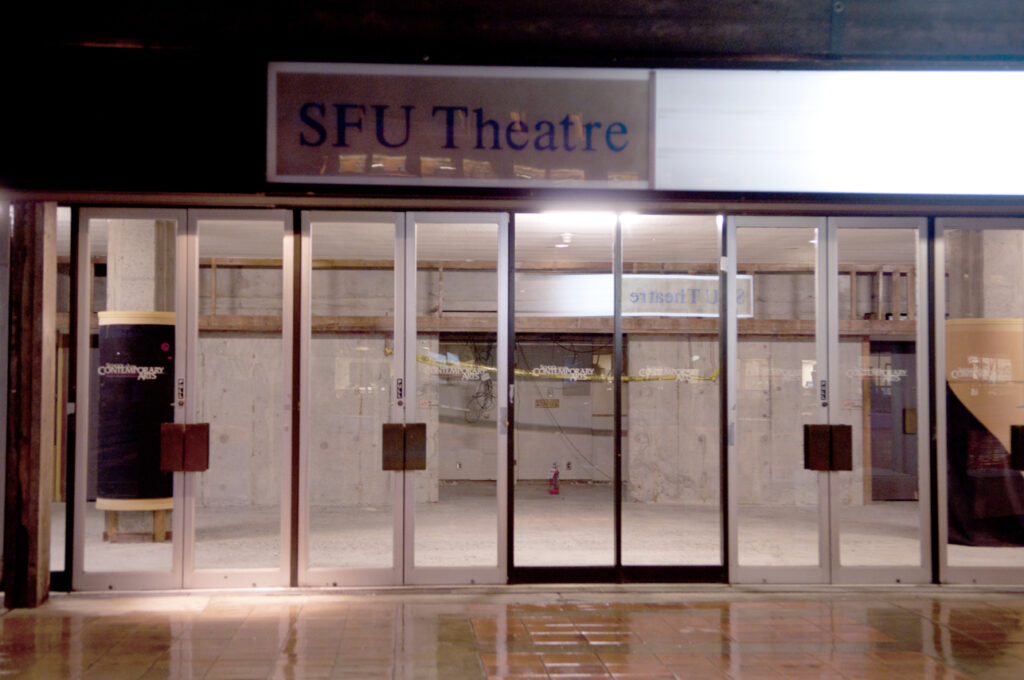
Ghost Town: SFU's Absent Arts Community


I’m not the first to observe the state of SFU’s arts community — or put more broadly, culture community. There is a unique aspect to SFU: our main campus resides on a mountain. Sure, the view may be nice and the air may be fresh, but what does this cloudy isolation do for our sense of community? I ventured to several SFU campuses to get a feel for our arts community and how it functions within our body politic.

SFU Woodward’s was an obvious first choice, being the home for contemporary arts. I wandered in on a Tuesday afternoon, feeling varying degrees of intimidation as I went into the Audain Gallery to see the current exhibit, Mapping the Everyday: Neighborhood Claims for the Future. I found myself alone in the white room, black script covering the walls. Artifacts of various art forms made islands in the center of the room: old computer monitors, dried rainbow paintbrushes, rolls of canvas, and old VHS tapes were stacked haphazardly on several desks and bookshelves. I found the evidence of art, of things being created in and around SFU, but I couldn’t find a single soul to tell me about it. It was beautiful, but barren. An arts community does not exist solely in a gallery of course, but while there was art, there seemed to be no community.

Instead of making assumptions based on my outsider’s viewpoint, I decided to talk to a student who might have a bit more insight. Jessica Han recently graduated from SFU with a major in film and a minor in theatre production. She explains that the film program operates on a cohort system, meaning you go through four years with relatively the same people. Theatre is more mixed, but Han explains that what makes the community within the programs is the very nature of the program itself. “You have performance and production students working together on a school production. Theatre is a collaborative process in itself. When you’re collaborating, you develop relationships, and relationships make for a community. We go to each other’s project presentations to show our support,” she said.

This may be the case for the contemporary arts departments at SFU Woodward’s, but does this exist at the other campuses? “The community is fairly exclusive, especially now that we’ve moved downtown to SFU Woodward’s. But when we were on the Burnaby campus, other students didn’t even know [the FPA department] existed!” Han said.

The main vessel of the Burnaby campus, the AQ, holds the SFU Gallery, a tiny space nestled among science lecture halls.  The current exhibit by Lawrence Weiner, A Selection from the Vancouver Art Gallery Archive of Lawrence Weiner Posters, highlights the relationship between art and words.
Bill Jeffries is the art director of the gallery and has been working with SFU for several years. “Things didn’t used to be this way,” Jeffries said as he recalled SFU in the ‘80s when staff and students alike would go to the theatre, then spend hours in the campus pub. Now that the arts departments have been moved to the Woodward’s campus, there seems to be a lack of cultural capital up on Burnaby Mountain. He makes the valid point that the notion of community is flexible, and yet there doesn’t seem to be much happening ‘culturally’ at SFU.

“There’s no easy way to reach the students,” he said, concerning the amount of information provided for events like gallery openings and theatre performances. In the same vein, he also noted that the old theatre in the convocation mall is being turned into a lecture hall.

Andrew Zuliani, an English major at SFU, puts the state of the arts community more bluntly. “There isn’t one,” he said. “SFU is mainly a commuter school. There is constant relocation. By the time something gets started up and you get settled down, you graduate.”

Zuliani finds one of the biggest issues to be the lack of information provided for students looking to get involved, as well as the quick turnover rate.  For example, the English lounge is usually empty because not many students even know it exists.

“Wanting a community isn’t enough. Romanticizing the idea of a community isn’t enough.  It’s like adding rice grain by grain to a pile.” Zuliani adds that it is paramount that professors and grad students get involved if we are to have a vivacious arts and culture community.

There is art at SFU, but the problem of ‘community’ seems to lie in the fragmentation between campuses, lack of information provided, and passive commuter mindset.  There needs to be an equal amount of investment in the SFU arts community by both the staff and the students in order to mend the fracture.

Originally published in The Peak, January 23, 2012

Thursday, 5 January 2012

Auld Lang Syne: a short story


My fridge was consistently stocked with a box of white wine.  Dry white wine.  Everyone thought it would always be this way.  I always thought I’d be the one with the spacious apartment that was built during the last Great War, the tangled Christmas lights tossed into the closet haphazardly, the stack of varied magazines as a coffee table.  I always figured I’d be able to drink coffee throughout the day and only have my own lack of appetite to worry about.  But, as I quickly learned, things don’t last.
            It began with John.  He was handsome; I was stubbornly independent.  I met him while working in the office of a construction company, filing papers and conducting company wide surveys.  I was a pragmatist of sorts; I was set on a certain track of owning a closet full of shoes, of drinking too much, of eating sushi out every Thursday night.  I worked early mornings, caught the bus at six to make it to work for seven.  There was laundry on my floor, a cupboard full of candy, rows of dresses in my wardrobe.  This wasn’t what I’d always be doing, I knew that; I had not gone to university for four years to study English only to become an accessory to fork lifts.  I did not necessarily desire to be another gear in the mechanisms of highway construction and arrogant architects.  I always figured I would enjoy things now, while I’m young, I could worry about having a real career later.  That’s what they always said, You’re young, worry about it later. 
            “Hello love, you look dashing in that dress.  I brought champagne.”  John had a crooning voice, a sort of lilt at the end of his sentence, like everything was punctuated with a question mark. His deep receding hairline was handsome on his face, the narrowness of his cheeks and greenness of his eyes serving as a reminder of his novelty.  I suppose he was a sort of cookie-cutter man, the type I went mad for: intellectual, sensual, well-dressed.  I had dated several other versions of him before.
            “Good.  I hope it’s dry”
            New years had come around again, full circle, imposing its overinflated ego on everyone.  There was always so much pressure on this day, this evening, to be fantastic.  It was considered an indication of what the New Year would bring; often, much of the same.  Resolutions would be formed, and then broken a week later.  Weight-loss memberships would inflate, then plummet two months later. Closets would be cleaned thoroughly, then oversized coats and broken vacuum cleaners would resume their original positions.  The year would masquerade as being something New, something Fun, would call itself Opportunity, only to reveal itself later as having the same receding hairline as the year before.
 John and I had been invited to a party on the top floor of a hotel.  The penthouse, I suppose it was.  His friends were of the yuppie variety: mad with entitlement and thin silk ties.  I can’t say I wasn’t drawn in, but I liked to think I played the detached card well enough to fool them.
            “Johnathan, do you think my lips are too red, or are they just the right kind of red?”  It was an answer I didn’t care to hear, but they were words to fill the cab.
            “They are just the right kind, like blood red strawberries.  They’re much too much for my heart, really.”  He reached over and took my chin in his hand and kissed me wetly on the mouth.  His teeth were like jagged hedges, neglected by the despondent homeowner.  I entertained myself by running my tongue along each crevice, imagining how the overlaps and pointy eyeteeth formed each word.  His mouth was a math equation I was busy solving.
            “Yum.  Cordova and Abbott, please.”  I instructed the cab driver, anxious for a glass of champagne.  I didn’t particularly care for New Years, and planned on spending it drunk and spouting off movie trivia.

            The room was filled with the Chemical Brothers and I made a beeline for the cocktails.  Johnathan gathered around his co-workers, recently married and perfectly groomed.  He was anxious because his best friends had all been married in the past two years, plucked off, one by one, like flower petals. His bachelor sensibilities tended to repel all things domestic and comfortable.  His sofa was leather and stiff and modeled after the sixties and his liquor cabinet was unlocked; he wasn’t planning on having children anytime soon.  This suited me fine.  Children and marriage were things I knew I’d want to do later, but later being a far distant future, perhaps in another dimension, a place where I wore flower-print aprons and rolled dough.  That place was not yet here.
            I poured myself an extraordinarily strong corpse reviver just as one of the wives sauntered up to me.  Janice was tall and blond and had the kind of eyes that made you wonder if she had a soul or not. 
            “Felicity! Darling!  Tell me, where did you find your dress? It is absolutely darling!” She was also the kind of woman that sugar coated insults with compliments.
            “Ah, this.  I found it second hand.  Fit like a glove.” I think I saw her choke on her tongue in slow motion.
            “Just Lovely!  Now come dance with us!”
            The rest of the evening found vodka giggles, sore feet, flirtations and weekly gossip.  I amused myself seeking out faces in my champagne bubbles, and  I revealed to whoever would listen that the European release of The Shining was actually twenty-four minutes shorter than the American version.  I sat with the other women as they commented on whatsername’s whorish ways and whatserfaces’ out-of-control shoe shopping habit, paying each topic a generous heaping of false attention, just so I wouldn’t be sought out as the traitor.  I didn’t care to argue myself out of being a communist tonight.
            I was beginning to regret agreeing to come to this party.  I had told Johnathan I had nothing in common with anyone, and I had been anticipating this intense need to get intoxicated.
            “Mmm, it’s almost midnight.” I felt Johnathan’s breath on my neck before I heard him speak.  I was ready to just leave with him now, go back to my apartment and make love to him on the leather couch until two am.  I didn’t care about the procedures or protocols New Years insisted upon; the Newness of it all demanded something of forgiveness and review, and I wasn’t particularly partial to sentimentality.
            “Ten…nine…eight…seven…”
The husbands and wives began to chant together, converging upon each other with the greedy eyes of a bureaucrat.  For them, the stroke of midnight held so much importance, so much weight.  The way they spent tonight is the way they would spend the rest of the year. 
“Six…five…four…”
The women grinned and the men put down their drinks.  Feminine hands ran up suit arms and rested at the elbow.  This moment was frozen as a moment of significance for them all.
“Three… two…”
Johnathan pulled me in front of him, looking into my eyes with such intensity, I couldn’t tell if he was drunk or not.  He reached into his front pocket and began to kneel down.
“One!  Happy New Year!”
I saw him mouthing something, but couldn’t hear what words were formed over the horns and clinking of glasses. 
“What?”  He pulled me down to his level and I felt his lips before I heard him say, “Will you marry me?”


Felicity closed the trunk at the foot of her bed with a final thud.  Glancing around her barren apartment, she maneuvered her way through the maze of boxes and grabbed the bottle of wine sitting on the bed-side table and screwed off the cork, pouring a generous amount into her glass without looking.  Her eyes never left the top far corner by the front door.  The white washed walls were more like a tinge of gray now, tiny holes remained as reminders of old calendars and photographs that had been pinned there once.  She took a large sip of her wine.  It could have been water.  That one spot, up on the left, bothered her.  Between the edge of crown molding and dark wood doorframe, there was an inch of green tape.  The doorbell rang, and she didn’t even flinch.  She couldn’t remove her eyes from that green tape.